Saturday, July 15, 2017

Day 27 & 28: Firinge!

Good morning!

Day 27
I was going to write about yesterday but it ended up being later than I expected. But anywho, yesterday after breakfast Hannah and I met with Dr. Hanson to see what we would do today. Hannah and I both suspected that we would be analyzing data yet. But, we got there and Dr. Hanson wanted us to do market surveys! She helped us prepare some questions and what kind of things we should take a look at while we were at the market. She rounded us up a driver, who had very good english might I add, and a gene bank worker who knew the way around markets. Hannah and I jumped in the jeep (it was actually a Land Cruiser) and away we went.

Our first stop was at rural town not too far from Addis. Unfortunately, it was not market day so we went to a small mill that was grinding different feed ingredients. They had wheat, barely, and teff. With a few different varieties and qualities of each. We asked for the cost per kilogram and per quintal (100 kg). Once we had the data from the mill, we went next door to a chicken farmer. Hannah was able to survey him on his feed and farming for her research. When we finished up in that small town, we went back into Addis. There was actually a very large cattle market going on. But, because it had rained almost all night and most of the morning, it was so incredibly muddy. We didn't even dare go down the hill to actual market. So instead, we stayed up by the railing and watched from afar and we even pet a few Zebu that were up by the railing. The largeness of this cattle market was due to Wednesday's and Friday's being fasting days for Orthodox Christians. Cultural knowledge: Though they do not eat animal products on these fasting days, they would by the cattle for the next day. Another thing with the beef market is interesting. A lot of meat stands will have either a red cross or a moon and a star on the outside. The cross stands for a christian meat stand and the moon with the star stand for a muslim stand. The only difference is when the bull/steer is slaughtered a difference in prayers is said over the animal. So the meat can be either christian or muslim. At this same cattle market, when we were walking down the railing to get a better look at what was happening a group of small boys were laughing and saying "Firinge! Firinge!". Which in Amharic, it means foreigner. I couldn't help myself but laugh and they began to laugh even more when I did. Once we agreed that there was no data to be found for us at this market, we got back into the car and went back to ILRI for lunch.


At lunch with Dr. Hanson, we talked about our morning and what our afternoon was going to look like. At 2 pm, the same guys from the morning, came to pick us up and take us to a town west of Addis. It was about an hour and half drive. But, it was super pretty out there. Like, 'the real' Ethiopia. The town we went to was called Holetta and they too did not have market day today. So, we went into different shops that sold feed ingredients and got prices. While we were there, another group of boys followed us around for a bit saying 'Money! Money!'. Hannah and I just laughed. They were also playing with bull-whips. Hannah gave it go but couldn't get the snap down quite right. It was still fun. The first shop we went to, there was man that began to follow us as well. He asked us how we were then began to speak in Amharic to our driver and translator. Once we got back in the car when we finished, the driver told us that the man said we were from the government and were collecting taxes. He also said that the government paid for white people and that the store sales people should not tell us the correct prices for these items. Because we didn't know what was going on at the time, it was pretty funny laugh about later. We drove back to Addis and stopped at market that went on everyday. Shola Market. It was so incredibly big and one could very easily get lost. But, we followed the translator and found someone selling eggs and chickens for Hannah as well as someone selling grains. They had one of everything! It was super cool to see and we were able to get really good data. We finished up and headed back to ILRI. We talked to Dr. Hanson about our day and she was glad that we were able to get solid data on a variety of feed ingredients. 

(There's actually restaurant in this plane.)

Later that night, Tigist was at the Zebu and wanted to take us out to dinner. We went to the Chicken Hut and yes, I had a cheeseburger at a chicken place. It was very good! I also tried pineapple Fanta, it's for sure a new favorite. We talked about our projects, more comparisons to the U.S., and just life in general. We got back just in time for me to fill out my laundry sheet, shower and get to bed. It was a very busy day but it was so fun!

Day 28
Today, Hannah and I don't have much planned. Dr. Hanson wants Hannah to go to a market the sells eggs and dressed chickens to look at the prices. We also want to visit a brand new mall that's been built not far from ILRI. We plan to go out once the rain lets up (if it does). As for tomorrow, we are going to church with Tigist and after Dr. Hanson has invited us to lunch with her, her husband, as well as some of their friends originally from Ethiopia that live in the U.S. It should be a fun day and I'm looking forward to it!

Thursday, July 13, 2017

Day 26: A little data & A little culture

G'day friends!

This morning, Hannah and I met for breakfast at a little bit later time so we could sleep in a bit. I had a piece of banana bread, strawberries, and an omelette. Afterwards, we headed to the genetics building. On our way over we here this tapping on the glass coming from one of the forage offices. It was Dr. Hanson. She was waving profusely and smiling. We went to her office and talked about our experiences yesterday while at the farms. She challenged us with more questions and gave us some more food for thought on our topics.

She sent us over to our desks that she has given us to work at on the first floor (the forages and gene bank floor). We entered in the answers and data from our surveys to our excel sheets and started to analyze the data. By the time we finished with that, it was lunch time already.

Dr. Hanson told us that the almost the whole forage office was going to a 'baby shower'. One of their colleagues wife had just had a baby boy about two weeks ago. This was their second child. We all walked over to their house on campus, together. In Ethiopia they have a celebration and get together after the baby the baby is born. Dr. Hanson and we were thinking it was due to the possibilities of problems that could happen especially back in the day with a lack of doctors or help. Dr. Hanson also shared that normally the women spend 1-2 months at home with the new baby. At the celebration, they had food, a traditional coffee ceremony, and a blessing for the mother. The food was very traditional and being that the colleague is from southern Ethiopia, the food choices were from that region as well. We had bread and false banana (a rubbery, flat piece of root from a banana tree that does not produce bananas) that were the 'scoops' for the kitfo or minced meat with spice, cottage cheese and cottage cheese with spinach or herbs (it is not like the cottage cheese that we know!). There was also a food made of barely flour with butter and hot pepper in the center called genfo. This dish is only served after a baby is a born. The guests eat it but after everyone eats, the women have a blessing of a single dish of genfo then for however many more children the mother wants, the women serve her a scoop of the genfo. Then a few people say some words of wisdom for the family and the father opens the gifts.


It was very cool to see a traditional get together and try some more traditional food. Although it may not be my favorite, I can at least say that I tried! The parents were also so kind in welcoming us all into their home to celebrate the birth of their new child. I enjoy being able to experience all these new things and meet these people.

Right now, Hannah and I back at our desks continuing on our data and questions. Once we are finished up here around 4 o'clock or so we go back to our hostel's and relax and get some dinner later on. Currently, we are unsure of what we are doing for tomorrow. Dr. Tadelle is supposed to return sometime today and hopefully give us some insight as to what we should be doing tomorrow. We will have to see, tomorrow!

Ciao!

Wednesday, July 12, 2017

Day 25: Data Collecting

Hi everyone!

Today was another day out at Debre Zeit. After breakfast of toast and strawberries we left at 7:30 am. Our first stop was at GGK Farm. This was another large scale farm but still 'old-style' in it's production. They milk completely by hand. They had 75 Holstein Friesian dairy cows and A LOT of chickens! She answered my questionnaire about their farm that I will compare with the milk yield data that I currently have. When I finished, Hannah asked her about the chicken production. After that she took us the building where the feed was mixed. They buy ingredients individually (like most farms) and mix the feed on the farm. We then made our way over to the dairy barn. Then we visited the chicken buildings. They had laying hens, pullets, and cockerels. There's a lot of management that goes into these large farms!


The next farm we stopped at was smaller with only 15 cows. We were not actually able to visit the cows at this farms because the manager had to go to church. But, I got through my questionnaire and Hannah completed hers about the chickens as well. Where we met the manager and his family seemed to be in like a small village. There were about 4 or 5 homes centered around a main middle area. There were some trees in the main area and between two trees was a highly resourceful engineered swing. The seat was an old plastic bottle (about the size of a laundry detergent bottle) and the 'rope' was old rubber. A small girl was swinging almost the whole time while we were there while she smiled and stared at Hannah and I. We finished up there and headed to the next farm.

(The enumerator is in the tan jacket and the manager in the red)

All three farms were within a half mile or so of each other. Our last stop was at Debre Zeit Swine Farm (makes sense right?). They had hogs, dairy cows, and chickens. They also grew corn for silage and their own alfalfa. We sat down with the dairy manager and he answered all my questions. This was the only worker that was able to communicate directly with me because he had very good english. He didn't know too much about the chickens for Hannah, except that they were broilers that would be sold. The farm just happened to be right next to the slaughter house too. He took us to see the holstein bulls that would soon be slaughtered as well as the actual milking cows. Hannah and I were both very impressed by the cleanliness of the cows and their pens. The manger took me to see the dairy parlor as well. They used both machine and hand to milk. He said that sometimes the automatic milker breaks down but otherwise it is efficient. The cows just have to walk in one side and follow the 'path' while they get milked and go out the other door and back into their pen. This farm also had one of the best yielding cows of the farms I've visited. They showed me one cow that was producing an average of 34 L a day which is tremendous for this area. In the U.S. an average dairy cow is producing about 30 L a day.


Until next time!


Tuesday, July 11, 2017

Day 24: Down to Work

Hello friends!

This morning after my breakfast of banana bread, banana pancakes, sausage, and pineapple juice, I was ready to go! I was super stoked to help Dr. Hanson in the gene bank. But, when I got down there she began to tell me that she wanted me to focus on my project and not just do busy work. She wanted me to get everything I could out of ILRI and Ethiopia. She didn't want me to have the 'free time' that I was having. So, she brought me to her office and she began to look at the questions I had created. She asked me what I thought about adding nutrition and economics to the picture. I worry about the economics (mainly because numbers and I don't go well together!) and how I was going to wrap that into my project. But, this is now a challenge. Before, my topics were not challenging me. Dr. Hanson wants to challenge me and make my time meaningful. So, that's what I'm going to do. 

She had me sit down with the data I already had from the database and make a table with the Farm Name, Location, No. of Milking Cows, No. of Calves, and Avg. Milk Yield. This table would allow me to figure out the large, rich farms compared to the smaller, poor farms. She said this would help to figure out which ones to visit and which ones I wanted to focus on for my research paper. I am so glad I have this guidance now. This is what I have been needing this whole time. She said so herself, this is the guidance they should of been giving me upstairs. I can't even begin tell you how much better I feel with someone 'on my side'. 

We went to lunch together and I had lasagna with potatoes wedges. They really like to put potatoes with almost every meal at the cafeteria even if it doesn't really go with! After that, we came back and Dr. Hanson helped Hannah and I get in contact with Dr. Azage to set up a time to visit smallholder farms. She also helped me create my questionnaire that will help me in writing my final research paper. 

I am so glad that she is helping us make our time meaningful and so much more worth it. Today was the day that I actually felt on track with what I am doing. I feel confident about my questions and I am very ready to visit Debre Zeit again tomorrow! Once I have some data from the questions I will share them with you! I can't thank y'all enough for following me on the highs and helping to keep my morale up on lows! 

Monday, July 10, 2017

Day 23: Chicken & Dairy Work

Hello everyone!

This morning was an early one but it was nice to have first pick at the breakfast! But as always, toast with strawberry jam and strawberries. Mikhel came to pick up Hannah and I at 7:30 to go to Debre Zeit. When we got to the research farm we had to wait for a few minutes until one of the main researchers was able to get us our lab coats. Once we got into the building and Hannah directed some people as to what she had to do, she got to work. The workers weighed the chicks while Hannah collected that data as well as the feed consumption.

Now, it was my turn for my project. The two farms I wanted to visit were high producing farms. I really wasn't sure what to expect but both were very commercialized. First we me met Muhammed, the enumerator. Then we went to Genesis Farm where they specialized in horticulture, chickens, and dairy cattle. But, they also had rabbits and even a monkey. We walked through the vegetables and plants that were growing, by the chicken building, and past the rabbit cages. We went to the barn where the dairy were housed. We had to disinfect our boots in a water solution before we could go in. All but two of the cattle were 90% or more of the Holstein blood. After getting to know a bit about the management practices and care of the cattle I asked what was something they wanted to improve. The barn manager said the they wanted to cross the holstein cows with a local breed (such as Boran) to improve the maintenance needs. Being that Holstein cattle are not a indigenous breed they require more management compared to local breeds. The two that were not completely Holstein were 50% Boran and 50% Holstein. The major difference was that these cows did not need as much feed at the Holstein cattle. We finished up there and went on our way to another farm. Alfa Fodder.


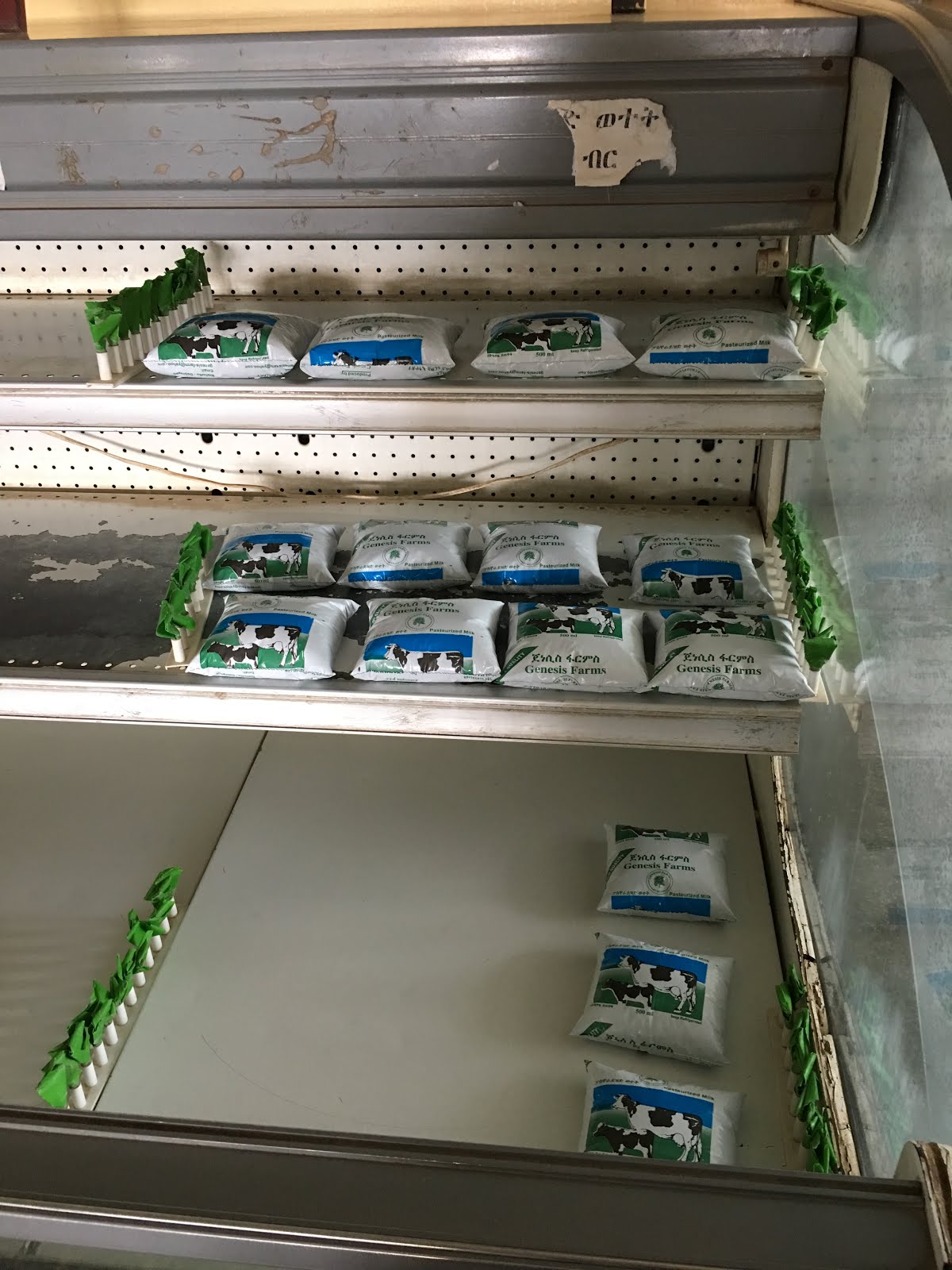
(Genesis Farms has their own market)

(The monkey, rabbits, chickens, and plants)

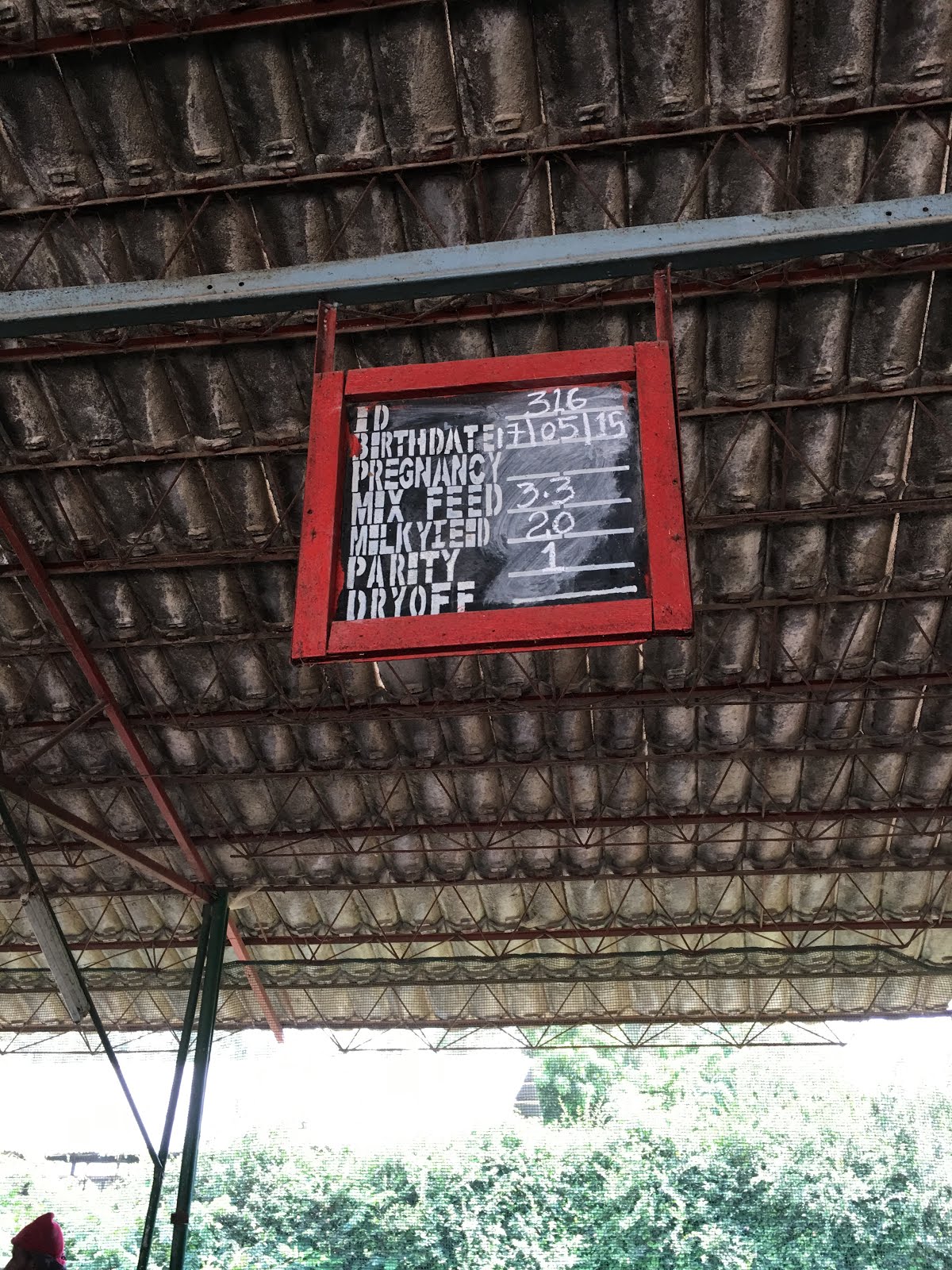
(They use automatic waterers, update each cows 'sign' daily, exercise the cows daily, and the all-black cows are the 50% Boran 50% Holstein crosses)

Unfortunately at this farm they did not allow us to actually go to the barns where the cattle were housed for biosecurity reasons. They had an outbreak of foot and mouth disease and lost a lot of cattle last year in May. They did not have a shoe bath with disinfectant either. But it was okay because I was able to get the gist of my information from the General Manager (& owner I believe). He was from Holland and the cows were 100% Holstein from Holland. Why he came to Africa? I have no idea, he told me he could only give me 10 minutes of his time. So I asked as many questions as I could think of so that I could compare to Genesis Farm and others.

(I didn't get any pictures at Alfa Fodder because we didn't actually see the cows)

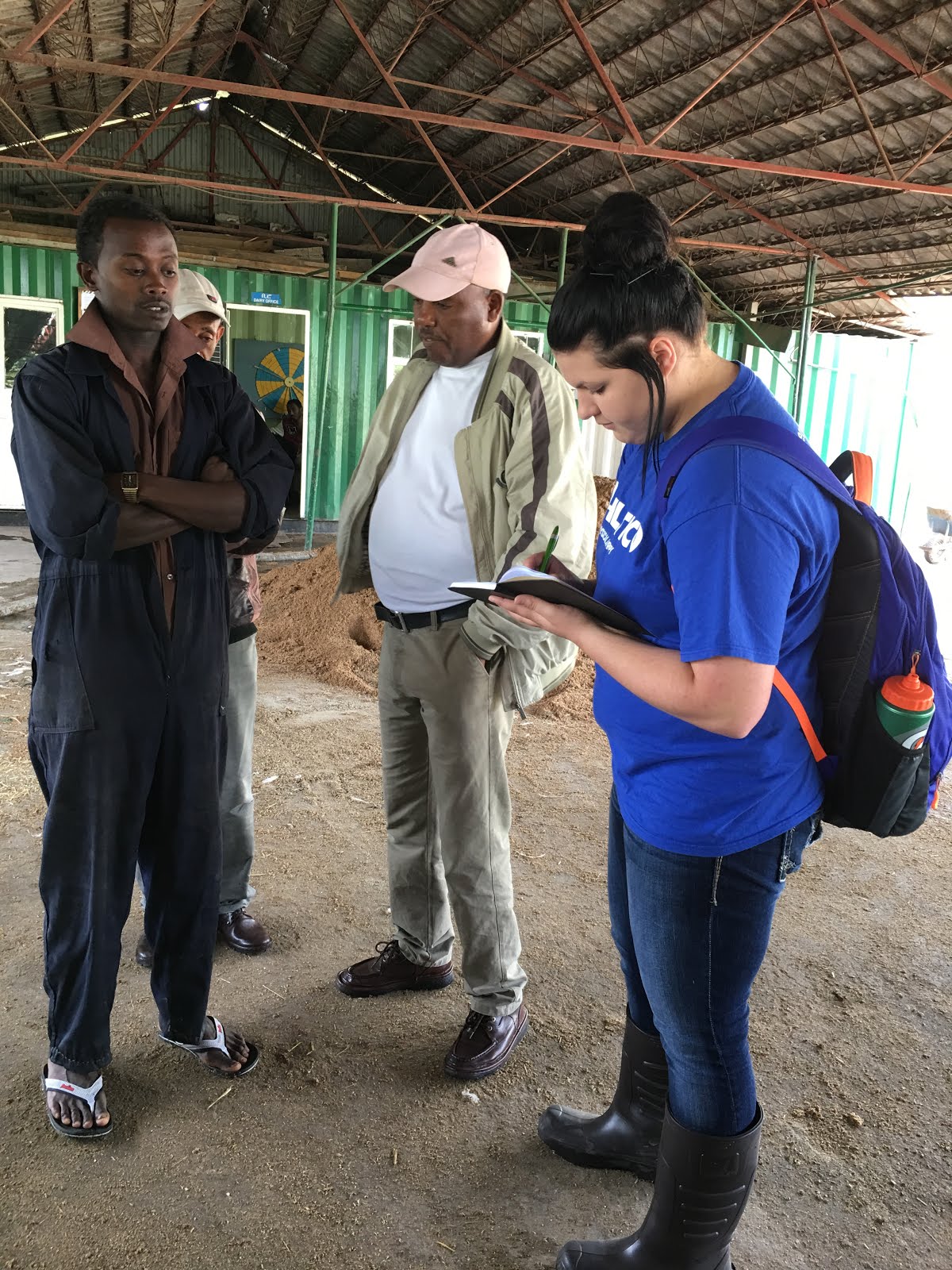
I was originally told that I wouldn't have time for questions for the thought that data being collected by the enumerator would take up time. But, today the enumerator did not take any data while were there. He simply went to the farms with us and somewhat translated the questions I asked (although he did not know english very well).

Hannah and I got back a little after lunch time. Sadly the Zebu wasn't serving food yet and the cafeteria was already closed. We decided to go to Kaldi's Coffee just around the corner from ILRI. I had the best BBQ and Ranch burger. Probably the best thing I've eaten since I've been here!
For the afternoon, we went to Dr. Jean Hanson to see what we could help with. Because it was already getting late in the afternoon she didn't want us to start in the cold room quite yet. So I helped her try to track down a paper she was look for that she needed reference. But, tomorrow we planned to go right away to start helping in the cold room of the gene bank. I'm actually pretty excited to start helping with that!

Sunday, July 9, 2017

Day 22: Sunday


Hello friends!

Here are some pictures from the the traditional Ethiopian restaurant that we went to with Boni, the driver, and one of her colleagues that works in the forage gene bank at ILRI. 


It was a very cool experience! This injera was actually better than the last time I had it. The meat was especially the best. Before getting our food and afterwards, they brought around a dish to wash our hands. The man would put some soap in your hands then over the bowl he would pour water over your hands while you washed your hands. That was interesting. I have videos but unfortunately I can't upload them to blogger. But while we ate and talked, there were traditional songs played with people doing traditional dances on the stage. So many people were there! It was very packed and by the time we left, two people had to move their vehicles so that we could get out! But all in all, it was a really fun experience! 

This morning, Tigist took us to church again. The sermon was about turning to God's light. Finding that light in the darkness. The pastor was very enthusiastic and it was enjoyable to listen to. After the service, we went to bible study. There we met a lady from Michigan who was very happy to be there and share in God's love with Hannah and I. It was quite interesting to listen to a range of ages in adults talk about the greatness that God offers in everyones lives at the bible study. I'm very glad that I have this opportunity to continue growing in my faith while I am here. 

After bible study, Tigist took us to Kaldi's Coffee. It reminds me a lot of Starbucks. You can find a Kaldi's just about every 100 ft! We got cappuccinos and just talked about different things. I am so glad we were able to connect with Tigist. Just about every other past intern has said that she became their Ethiopian mother. They were not wrong! She is a delight!


Here are pictures of the church!

We got back to ILRI and Hannah and I took naps. I'm not sure what we will do the rest of the day. But, tomorrow we go back to Debre Zeit to OFFICIALLY begin our projects! YAY!